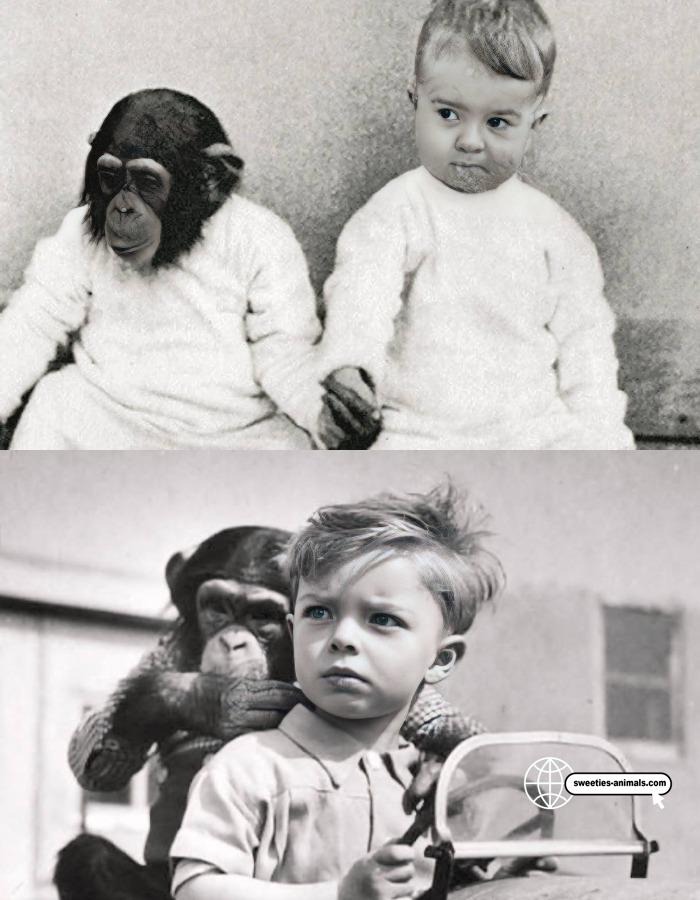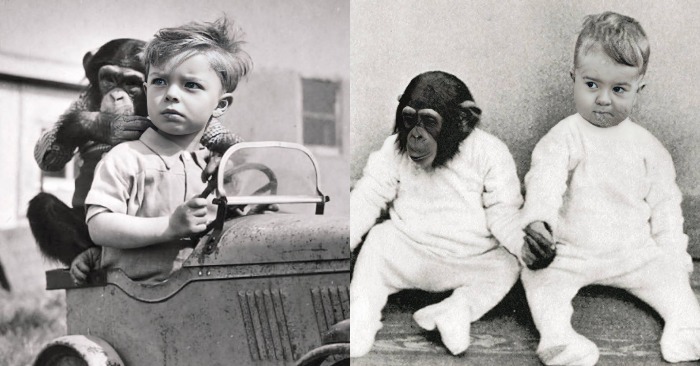
“A boy and a chimpanzee growing up together? 🤯🐵👦 Sounds strange, doesn’t it?”
Then you probably haven’t heard of this fascinating experiment conducted in the last century. 🧪🔬 The results shocked everyone! 😲 We reveal all the details below. 📖🔍👇
Nearly 90 years ago, a highly controversial experiment was carried out—one that still sparks debate to this day.
One of the central figures in this story was Winthrop Kellogg, a psychologist who, in the late 1920s, was pursuing a revolutionary theory that he hoped would cement his name in the scientific world. He had always been fascinated by cases of so-called Mowgli children—human children raised by animals who later struggled to reintegrate into human society.
Kellogg wanted to study the interaction between an animal and a human child in a controlled environment. Clearly, sending a baby into the wild wasn’t an option, so he devised a different approach—bringing an animal into a human household. Around this time, Kellogg and his wife Luella had just welcomed their son Donald. Finding the right animal counterpart, however, wasn’t an easy task.
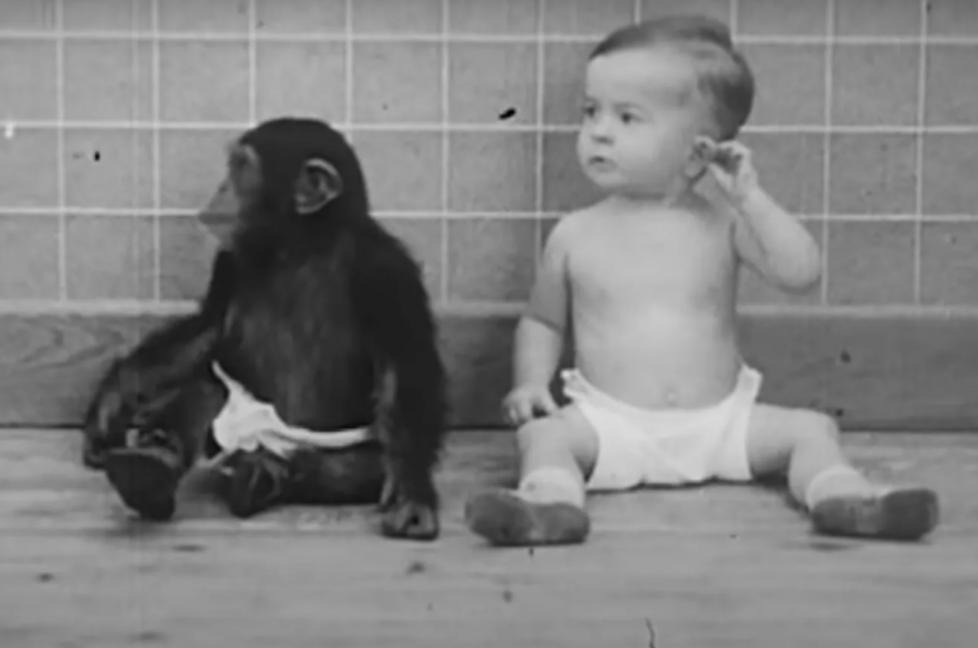
In 1931, when Donald was ten months old, the Kelloggs managed to acquire a female chimpanzee named Gua from a research center at Yale. At only 7.5 months old, Gua was nearly the same age as their son.
The couple committed to raising Gua and Donald as equals, treating them as if they were siblings. They had their own cribs with bedding, were dressed in children’s clothes, and played with toys. They even had personal hygiene items and learning materials.
Gua quickly adapted to her new environment. She preferred sleeping in a crib and became frustrated when denied a mattress. Winthrop observed that she developed faster than Donald—she quickly learned to drink from a cup, use a spoon, reach for objects, and even open doors.
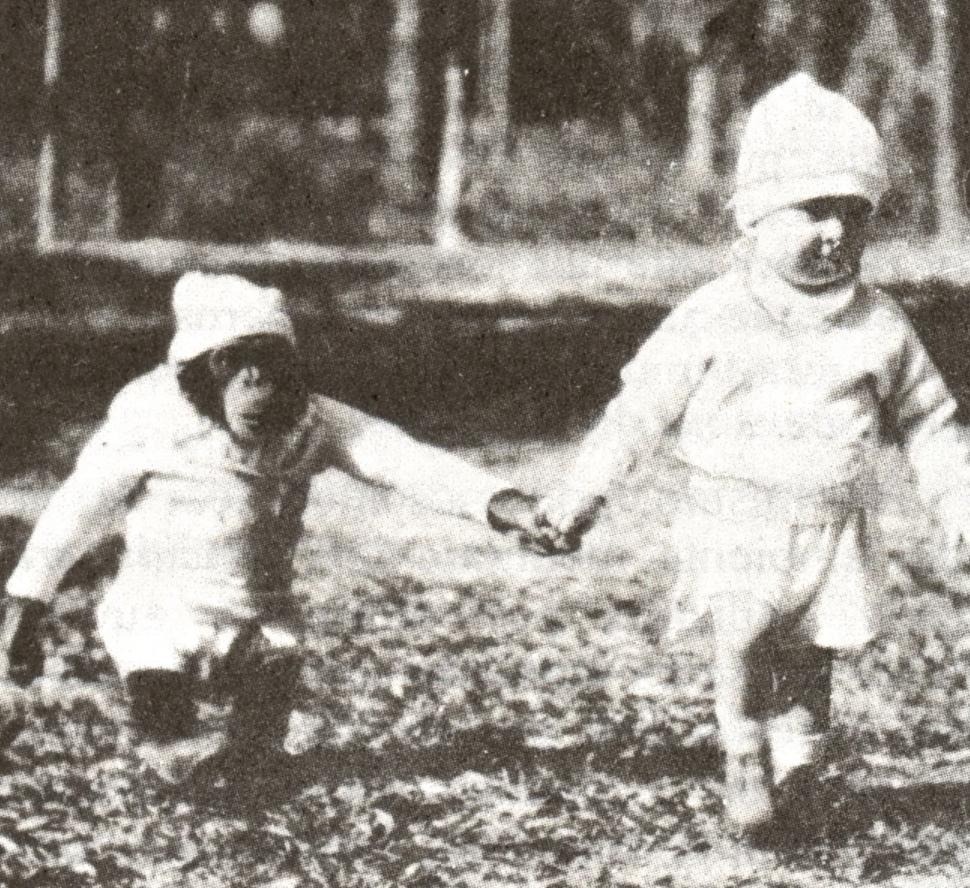
However, this rapid progress wasn’t surprising. Chimpanzees have shorter lifespans than humans, averaging 40–45 years, and they reach puberty at around age four—far earlier than humans, who typically enter adolescence around 13 or 14.
Within six months, Gua was following simple commands and effectively expressing her needs. However, she struggled with tasks like using a potty or handling a pencil. Unsurprisingly, she also showed no ability to speak.
As Donald grew and began developing his language skills, something unexpected happened—he began imitating Gua. He copied her sounds and movements instead of progressing in human speech.
This outcome deeply concerned the Kelloggs. After only ten months, they decided to end the experiment, concluding that a human child could far more easily imitate a monkey than a chimpanzee could adapt to human behavior.
Kellogg’s experiment became widely known and sparked intense debate. Some praised his research for its insights into development and learned behavior, while others criticized it for its ethical implications—both in relation to his son and the chimpanzee.
In 1933, Kellogg and his wife published a book detailing their observations, exploring the complex relationship between heredity and environment. However, little is known about Donald’s later life. As for Gua, she was returned to the research center, but tragically died a year later from pneumonia.
Decades later, the experiment remains a striking example of ethical dilemmas in scientific research.